Vegetarian Food In Thailand

Despite Buddhism typically being one of the most prominent religions of Thailand, vegetarian and vegan food is actually rather hard to come by, particularly in Thailand’s capital city Bangkok.

You’ll find an abundance of skewered meats, grilled fish, processed meatballs, deep fried chicken and meaty fried… well everything, yet very little vegetarian protein alternatives. Tofu or vegetarian dishes are nowhere near as common as meat dishes in Thailand.

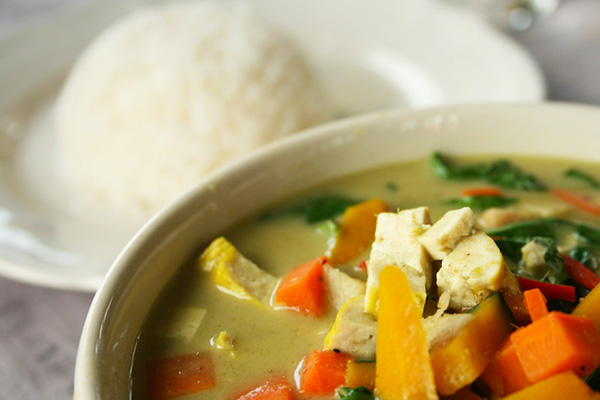
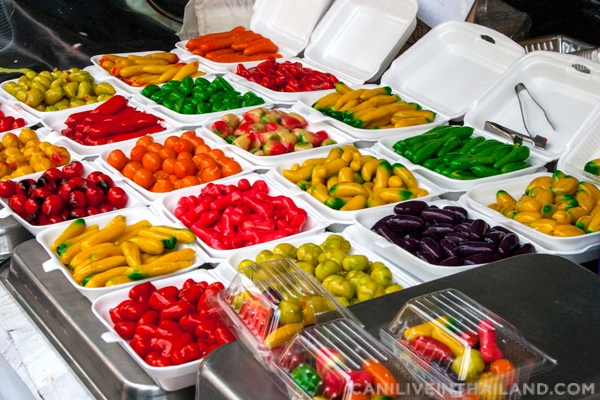
Thankfully, Thai people seem to love their eggs and you’ll commonly find a side serving of crispy fried eggs to accompany your meals. Or, if you’re lucky, you may sometimes come across the sweet, tamarind sauce coated and deep fried, hard boiled ‘mother in law eggs‘. Search out the right restaurants, and you’ll be able to order delicious tofu curry soups and Thai salads. Eating at some Thai street food stalls however, you may find that, as a vegetarian, you need to settle for vegetable fried rice or other unsubstantial alternatives.

thailand vegetarian

How to order vegan and vegetarian food in Thai language

For a more in-depth guide on how to order Street food in Thai check out my main Thailand street food phrase guide here. Remember, women use chan and men use pom for I. To be polite, add ka or krap on the end of sentence for women and men, respectively. When ordering vegetarian alternatives in Thai language, it’s useful to know these keywords and phrases…

Vegan: Jey
Vegetarian: Mang-sao-we-rat
I am a vegan: Pom/ chan gin jey
I am a vegetarian: Pom/ chan gin mang-sao-we-rat
I don’t eat meat: Pom/ chan mai gin neua-sat

Do you have a vegetarian menu? Mee a-haan jey mai?
Can I have vegetarian… (fried rice)? Ao (khao pat) jey?

If you don’t eat fish, be careful as a lot of Thai recipes include fish sauce – even if you do tell them that you are vegetarian. To make your order extra clear you can use the Thai phrases…

Don’t put … in it: Mai sai ….   (For example, Don’t put fish sauce in it: Mai sai nam bplaa)
I don’t eat …: Pom/ chan gin … mai dai     (For example, I don’t eat meat: Pom gin neua-sat mai dai)

Meat: Neua-sat
Fish: Bplaa
Fish sauce: Nam bplaa 
Beef: Neua
Chicken: Gai
Pork: Moo
Crab: Bpoo
Egg: Kai
Tofu: Dao-fu

Remember to add ka or krap or you might sound like a bit of an ass! Usually, a waiter or stall vendor will reply with…

Of course: Dai
No I can’t: Mai dai
Yes, we have (a vegetarian menu): Mee
No, we don’t have (a vegetarian menu): Mai mee

A vegetarian’s guide to Thailand

Okay, so it can be hard to find decent, cheap vegetarian street food in Bangkok, but you can still find some nice vegan and vegetarian restaurants around the city at not bad prices. Make sure to check out my guide on the best vegetarian and vegan restaurants in Bangkok here. Outside of Bangkok, the best place I have found for vegetarian food in Thailand is up north in Chiang mai and Pai. Many of the restaurants in Chiang mai are very vegetarian and vegan friendly with plenty of tofu substitutes and creative Western menus.

An absolute must for all vegetarians in Thailand is to visit the Thai vegetarian Festival. During this time in Thailand, 99% of all street stalls and restaurants will provide great vegetarian alternatives. There are some delicious vegetarian salads, noodle dishes and meat substitutes on offer – it’s a surprise that they don’t offer these dishes throughout the rest of the year in Thailand. You can read more about the Thai vegetarian Festival in my article here.

vegetarian3

Hairdressers in Thailand

beauty salon bangkok


Hairdressers in Thailand are cheeeap! If you stumble upon one of the ordinary barbers or hairdressers on the streets in the local areas of Thailand or outside of the main cities, you can get yourself a Thai haircut, wash and blowdry for as little as 100 baht. Cheap aye?

There are a couple of drawbacks to these cheaper, local hairdressers in Thailand though: It’s hard to know if they’ll actually be any good or even have any skill cutting hair; They very rarely speak English – most ladies’ worst nightmares when unleashing hairdressers on their luscious locks; They are only used to dealing with Thai hair types so they can be known to use the wrong hair products or chemicals and even damage western hair types.

My Thai haircut

When I injured my wrist on holiday in Thailand a couple of months ago, I found it hard to wash and do my own hair. Fed up of walking around looking like a dischevelled, scruffbag bird’s nest, I stumbled across a local Thai hairdressers in Chiang mai. It was a dark and dingy-looking, open-walled shop just off the main street charging 200 baht for a wash, cut and blowdry, and the hairdressers working there seemed surprised by my patronage. I asked, in Thai, for a haircut and wash, but only to cut a little… She ended up cutting off about 3 or 4 inches of my poor hair.

Also, on a recent drunken weekend in Thailand, my boyfriend ended up being taken to a Thai hair salon (which randomly had a pet squirrel running loose btw) by friends who showed the hairdresser a picture of a guy that looked like a cross between Mr T and Prodigy… Now that’s a hard look to pull off, but it does help if the hairdresser actually shaves your hair even remotely straight – not making it look like she did it with her eyes closed. Yeah yeah, it’s not a particularly good start to let your drunk friends pick out your hairstyle but it seriously looked bad… I think I could’ve had a better crack at it myself. Sorry for the Thailand hairdresser horror stories anyway, but just a heads up!

Never fear though, you can always opt for the more glitzy hairdressers in Thailand on the highstreets and in the malls of the city centres. A haircut and blowdry can cost from 400 baht upwards, but in some places they’ll speak English, have more specialist products for western hair and spend more time on their customer’s haircut.

Best Hair Salon in Bangkok

Where to find the best hair salon in Bangkok… Although I’ve not yet tried and tested them myself (I do plan to), these seem to be the most renowned and best hair salons in Bangkok, popular among expats because they speak English too:

Anderson hair salon Bangkok

Hair by Phonatip Bangkok Salon

Zen Red Hair Salon Bangkok *

*I am a little dubious of Zen Red hair salon in Bangkok, they seem to have mixed reviews but are meant to be specifically catered for western hairtypes and customers. Their website seems a little flashy to me as well, not as genuine as the other two.

How to ask for a haircut in Thai!

Dtong-gaan... – I’d like…

Dtat pom – Hair cut

Lem – Trim

Yawm pom – Colour

Sa – Wash

Bpao pom – Blow dry

Gohn noo-at – Shave

Dtok dtang noo-at – Beard Trimmed

Khae nit noy – Only a little

Yaa dtat hai san bpai – Don’t cut it too short


When using these phrases to get a haircut in Thailand, don’t forget to add ‘ka’ for women and ‘krap’ for men to be polite.


How To Order Thai Street Food

Thai Street food

The language can be a bit of a barrier when ordering street food in Thailand – there are not usually english menus and the sellers speak little english if any. It’s not a problem though, a lot of them can still speak very basic english to help you out. Street food in Thailand is so cheap and tasty that I highly recommend giving it a try – especially if you love to try real, authentic food.

I have given some useful phrases for ordering Thai street food below, but when attempting to speak Thai, make sure to add krap for men, or ka for women, on the end of sentences to make it more polite.

‘Issan style’ tray restaurants

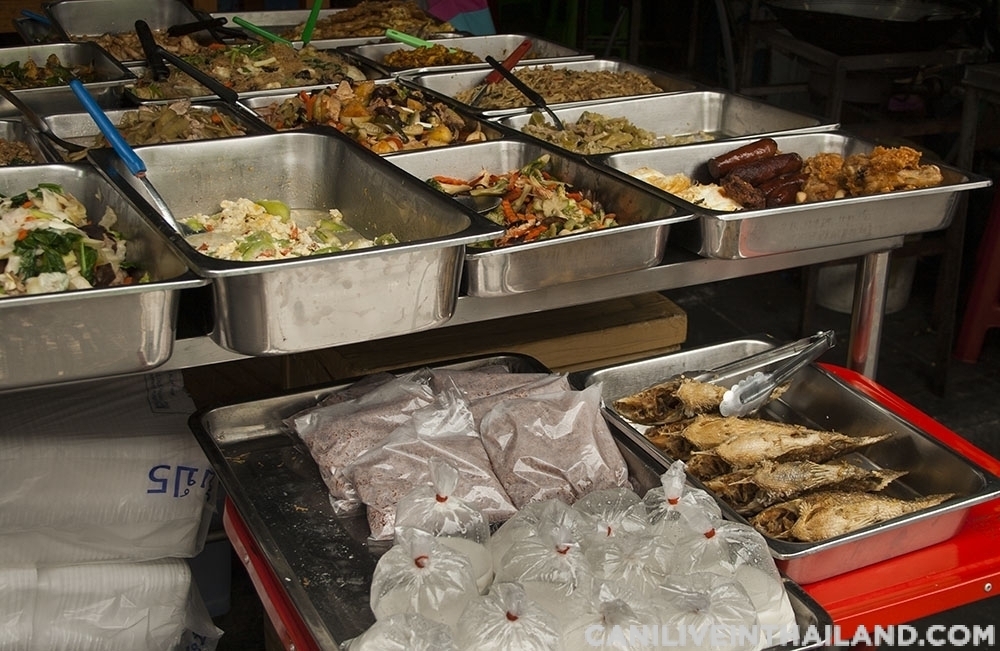
Occasionally you may come across street food stalls in Thailand that have their food already made and laid out in a selection of trays. They usually sell curry and sauce dishes to go with plain rice. It’s often easier to judge if you will like Thai street food by seeing it first anyway. The best way to order Thai food at the tray places is to just point, it’s pretty easy. You could also say the Thai phrases…

an ni – this one             an nan – that one
You could also say ao – I’d like: ao an ni krap/ka – I’d like this one please

street food

Tray Style! Foods a bit cold, but hey I’m still alive

They will simply dish your chosen Thai meal onto a plate and you will pay upfront, usually around 30 baht ($1). They also have polystyrene boxes for takeaway if it looks a little cramped for you to sit down.

gin tii nii – To eat in                       sai glawng/ sai toong – To take away (box/ bag)
tan nii – To eat in                            glap baan – To take away (lit. back home)

The first Thai phrase that street food vendors will often ask you is tan nii rue glap baan, or tan nii rue sai glawng – are you eating in or taking away?

laew… (duay) – and… (as well)       kai – egg
moo – pork                                     gai – chicken

Cook on the spot 

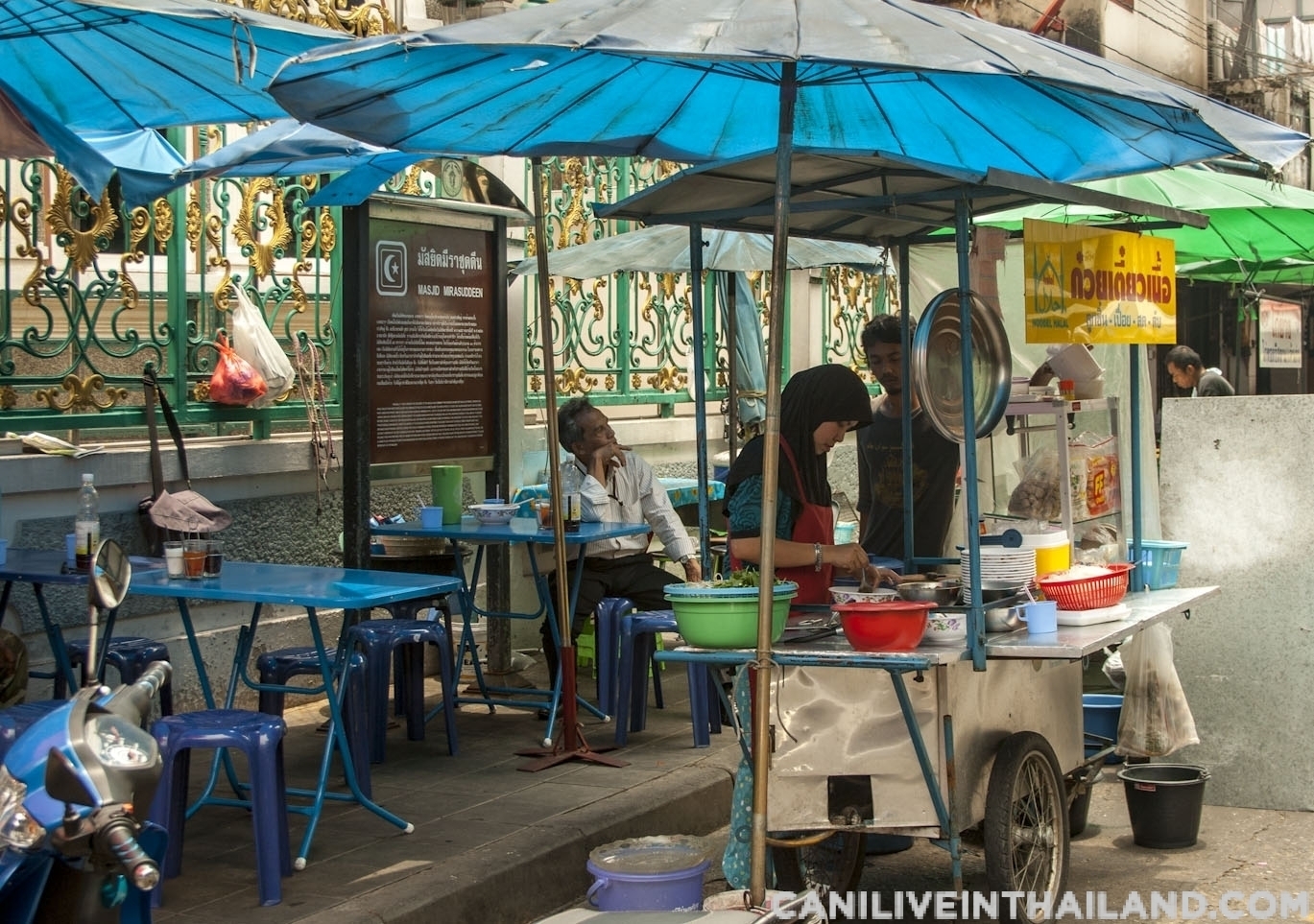
Sometimes you might come across a Thai street vendor cooking at a small, mobile trolley with a glass cabinet full of different ingredients. These vendors prepare dishes in front of you – usually noodle soup dishes or som tam (papaya salad).

streetfood

They can be the most awkward places to order Thai street food because they often don’t have english menus, or anything written anywhere for that matter, and don’t have anything you can get away with just pointing to. These are probably the healthiest places to eat though (glass noodles are the healthiest option, being made of mung beans: woonsen) and food costs from 25 baht a serving. Some useful Thai phrases for when you don’t know what the hell the street vendor is selling are:

ao neung tuuay/jahn – I’d like one bowl/ plate
arai aroi tiisut – What is most delicious?
mee maynoo mai – Do you have a menu?
mee maynoo arai – What food do you have?
mee maynoo nehnam arai – What dish do you recommend?
Ao – I’ll have it
Arai gor dai – Whatever will do
Baep nai gor dai – Which ever will do
Moo – Pork                                   Gai – Chicken
Bah mee – Egg noodle                   Sen nai – What kind of noodle
(Sen) lek – Small (noodle)              (Sen) yai – Big (noodle)
Pet – Spicy                                   Mai pet – Not spicy

Take a seat, and they will bring your food to you when it’s ready. At these places, you can help yourself to drinks from the fridge. When you have finished, they will add up the total from your table, you can just grab their attention with your money out and they’ll get the idea. Or a casual gep dtang ka/krap (Can I get the bill please)

 Thai Street Meat

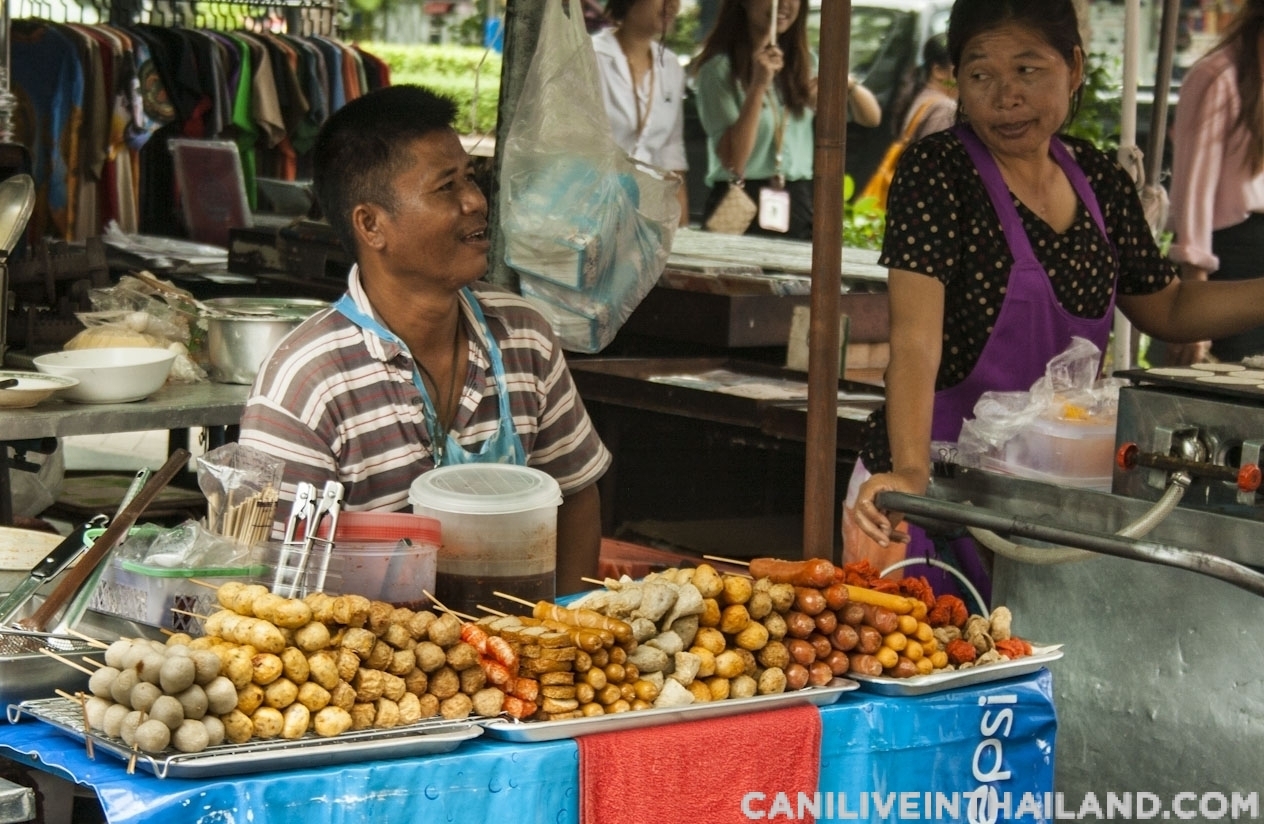
Some of the tastiest and most popular street meat in Thailand is Moo ping, also known as Moo yang – grilled pork. These are sticks of pork grilled with a barbeque sauce marinade and usually cost 10 baht a stick. There are also street vendors which sell various meatballs and cubes on skewers – reconstituted types of meat served in a plastic bag with chilli sauce. You can sometimes get sticky rice (pronounced ‘Cow Neo’) to compliment it.

streetfood6

Other Thai street food vendors sell deepfried chicken and sausages – again you can buy this with sticky rice and chilli sauce. A piece of chicken will typically cost around 20 baht depending on the size and type. With these guys you can just point and nod but it’s always better to speak Thai. With the skewers, you can just pick out the ones you want and put them in a pile to the side and they’ll heat them up for you.

Ao neun/sawng/sam mai krap/ka – I’d like one/two/three skewers please
Ao neung/sawng/sam chin krap/ka – I’d like one/two/three pieces please
ao cow neo duay krap/ka– Can I have sticky rice too
ao cow neo neung toong duay krap/ka – can I have one bag of sticky rice too

Fruit men

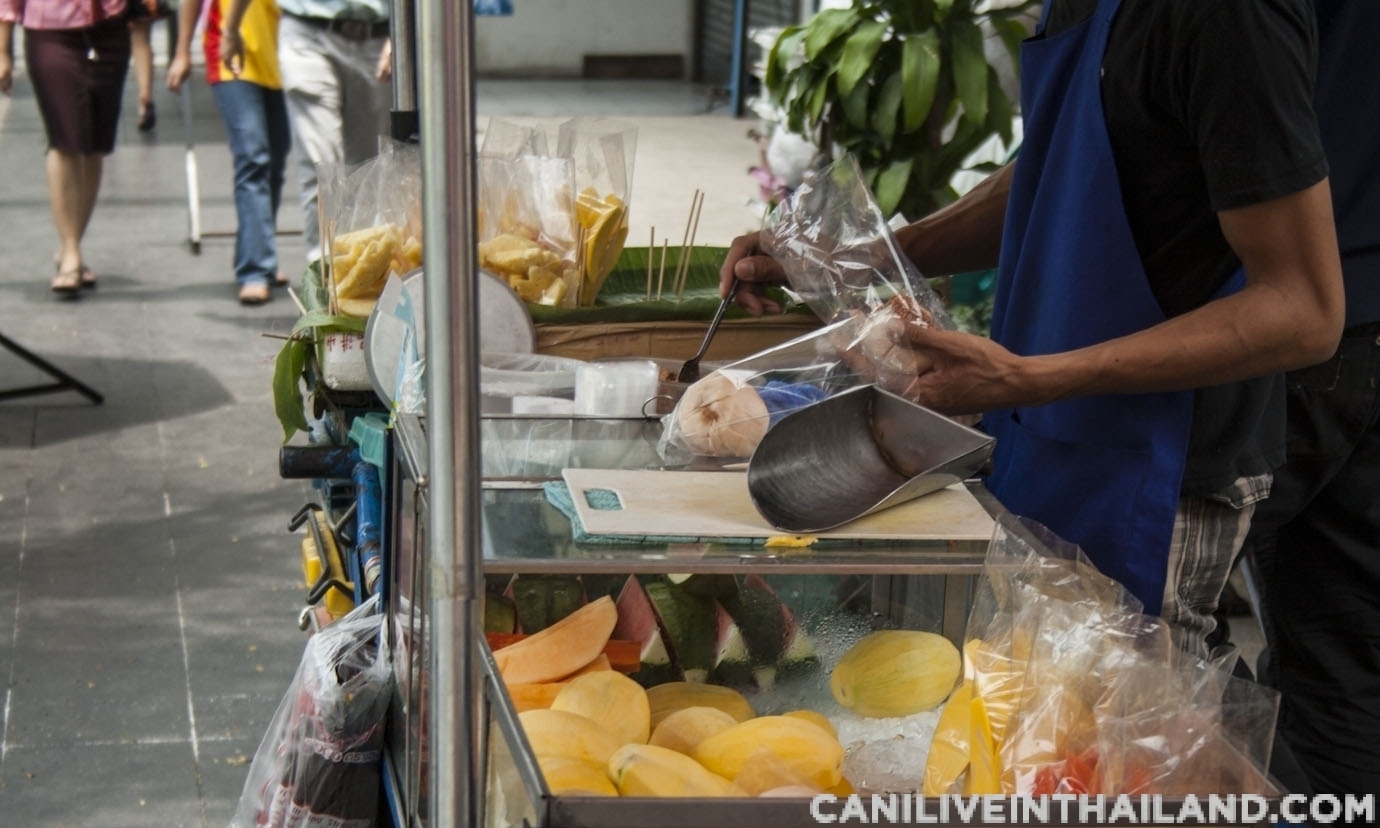
Another kind of street vendor to look out for are the fruit men. I love Fruit men. These guys wheel around a glass cabinet full of mangoes, pineapples, melon and sometimes rose apples and other fruits. Then, like a freakin ninja, they’ll chop your chosen fruit up for you and whack it in a carrier bag.

Thai Street Food

You can have a bag of sugar to go with it – a kind of salty tasting, sweet sugar. A little too much sweetness for my liking. An ordinary sized bag of fruit costs 10 baht.

Sa-ba-rot – pineapple                  Daeng-mo – melon                    Ma-muang – Mango
Ao (sa-ba-rot) neung/song chin krap/ka – I’d like one/two pieces of (pineapple)
Ao (ma-muang) neung/song luuk krap/ka – I’d like one/two whole (mangoes)

You use the word chin when asking for a piece of fruit or food, and luuk for any whole, round food item such as a whole mango or a steamed bun

Thai Street Fruit

I think she likes me

Mall canteens

Mall canteens, usually on the top floor of all the malls and department stores, should not be forgotten as an authentic, cheap source of food in Thailand. If you’re on a budget, they are useful as most meals only cost around 30 – 50 baht and they have practically every meal you can possibly order in Thailand under one roof. The canteen at the top of Terminal 21 in Bangkok is particularly good.

Head up to the coupon kiosk, hand over 100 baht and then they will give you a card, use the card to pay at whichever food kiosk you fancy, take the card back to the kiosk and the person will give you back the balance. Easy.

You can just point to the pictures or a lot of the staff speak basic english anyway. Or, you can just say ‘tii +number krap/ka‘ to specify which number meal you want. (See the Thai numbers below)

1 neung      4 See      7 Jet
2 sawng      5 Hah     8 Bpaet
3 Saam       6 Hok      9 Gao

Thai food outdoors

Eating cheap in Thailand

As food is one of my biggest weaknesses and ends up burning the biggest hole in my pocket of all living in Thailand, I figured it was the most controllable of my outgoings and so I made it my mission for the last month to eat on as small a budget as possible. Without starving myself to death however and whilst eating reasonably healthily.

Anyway, I managed to squeeze my budget down to 120 baht a day simply by eating mainly Thai street food. In fact, I’ve managed to live in Thailand off of just 15000 baht a month lately. Thats about £330 or $500 – 5000 baht for my rent and 10000 on everything else.

So there you have it – it is indeed very possible to live in Thailand Bangkok on only 15000 baht a month. But eat lots of street food.

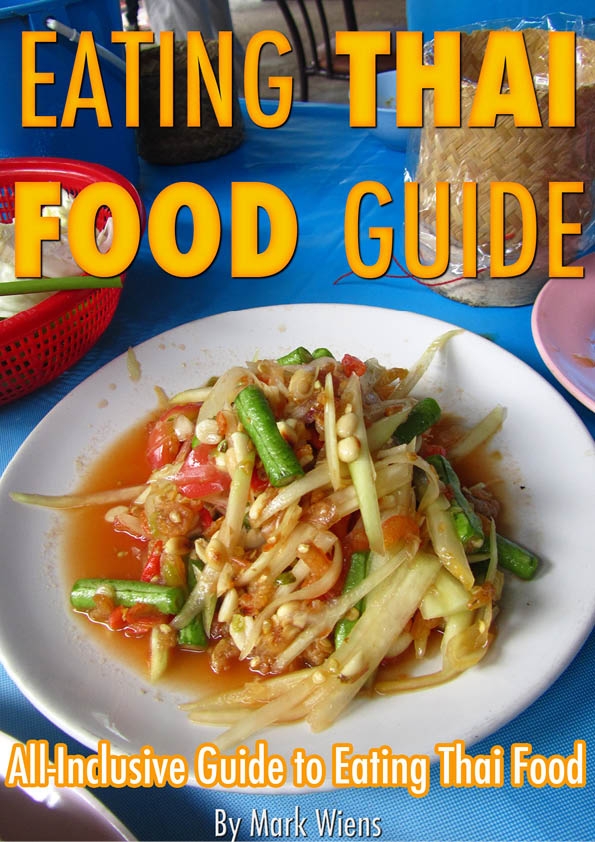
Still not satisfied? Eager to learn more useful phrases for ordering Thai food? Curious to know more about Thai street food? You might be interested in the Eating Thai Food Guide below – 100 pages of Thai food tastiness…

How to order Thai food
Buy the Eating Thai Food Guide eBook for only $7

Thai Slang

thai swear words

Thai swear words and slang should be used very carefully only with close friends, or in other cases Thai slang should even be avoided altogether. Really, the most useful reason to know some Thai slang words is if you just want to understand what other people are saying. By all means though, the slang words given below for ‘cool’ and ‘awesome’ are positive words and harmless to use in everyday situations in Thailand.

Thai Slang

Wat dee – Hey

Bpen ngai – How’s it?

Arai wa – What the hell?

Mong arai wa – What the f*** are you looking at?

Sentence + wa – Particle (Among (male) friends – kind of adds laid back, cool vibe like ‘dude’ or ‘man’. Very rude to use with strangers though)

Raeng – Strong (Kind of like, ‘Harsh!’ or ‘Burn’ after an insult or brutal comment)

Chiw chiw – Chill out, take it easy, ‘it’s easy’


Jaab (High tone) – Awesome

Jeng (Rising tone) – Cool (Usually jeng jeng)

Jaew (Rising tone) – Cool (about people)

Rêrt – Cool, amazing (used by females)

Fin – Orgasmic, sexy (Lit. Finale) e.g. This cake is orgasmic ‘kaek fin’

Wôoe – Way too, very

Sut dtaen (Falling, mid tone) – Extremely, f***ing (E.g. Rawn sut dtaen – extremely/f***ing hot)

Koht (Falling tone) – Extremely (Same as above but not quite as offensive)

Hia (Falling tone) – F***ing, Bad (E.g. Aroi hia – f***ing tasty!  Aai hia – bad person)


Cha nee – Pronoun for females (used by gay people kinda like ‘Hey bitch’, ‘Hey girl’ – lit. gibbon)

Poo ching – ‘Tranny’ or camp gay guy

Gig (High tone) – Secret lover, mistress

Dek naew (Low, mid tone) – Trendy kids (In a negative sense – troublesome, anti-social e.g. chav)

Dtao hua ngoo (Falling, rising, mid tone) – Dirty old man (Dtao = gae – old, ngoo – snake)

Jaao paw (Falling, falling tone) – Gangsta, mafia

Sip bpaet mong gut – Someone who decieves/ rips people off/ scams others for money

Neua hawm (High, rising tone) – Hot/ attractive person, popular

Jao choo (Falling, high tone) – Butterfly, Womaniser

Dtao lan bpee (Low, falling, mid tone) – Old fashioned, out of date

Som lon (Falling, low tone) – Unexpected fortune/ luck

Kee ngok (Falling, low tone) =  Kee neeiw – Stingy

Bpon jai – To be unfaithful, disloyal

Nam Khan (Falling, mid tone) – Annoying (Farang nam khan is used to describe ‘ill-mannered’ or inconsiderate foreigners)

Mot dtoot (Low tone) – To be skint, broke


Aai kwai – Idiot, up yours

Dtaw lae (Mid, high tone) – Bullshit, liar (Usually repeated with ‘lae’ first being pronounced with a high tone, then rising tone second time)

Hee-ak (Low tone) – Bad, shit, terrible

Heng suay – Bad, shit

Loi toi (Rising, falling tone) – To suck, be rubbish


Thaipod 101 Review


Thaipod 101 consists of a range of conversation lessons in varying difficulties, video lessons and a dictionary of the 100 most used Thai words (or many more depending on the package you purchase). The conversation lessons run for roughly 10 minutes in length, they will play a conversation first at normal speed, then slowed down and lastly alongside the english translation. After playing the conversation three times at the beginning, the two Thaipod 101 hosts then go on to talk about interesting facts about the culture and go into more detail about the content of the conversation. This breaks up the Thai lesson quite nicely and gives it a little more of an informal feel.

There are some other smart learning tools with Thaipod 101, for example tagging any words that you might be having difficulty with and then using them as flash cards. They also have PDFs you can download to supplement the lessons. The basic package costs around $8 for one month (N.B the longer you sign up for, the cheaper it gets) and you can sign up for a free 7 day trial to see if you like it first.

Thaipod 101 Review


The downside

I did find that the hosts on Thaipod101 spoke quite unnecessarily quickly – in the beginner lessons they spoke a little fast for someone new to the language but don’t even get me started on the intermediate lessons! Way too fast and mumbly… I always used to think they must just be warming us up because Thai people in real life must speak super fast. Well no, actually they don’t! A lot of Thai people speak really quite clearly, so it is completely unnecessary!

But while I’m on the subject of the Intermediate lessons… I really did not enjoy these lessons. They replaced one of the hosts, Ryan, with a new guy who just had absolutely no character, or life in him for that matter, whatsoever. I really don’t mean to be personal, but his voice was just so tired and mind-numbing… it sounded like he did not want to be there doing his job, he just sounded depressed. Not particularly stimulating when you’re trying to learn a language from this voice. Apart from the dreary tone of these intermediate lessons, I found them to be a little useless in content. Maybe not so much grammar wise, but as for the vocabulary – it was all a little too specific and useless for everyday conversation. It would have been much better to be learning more commonly used words instead.

Another problem I found with Thaipod 101 was that they tended to gloss over and neglect some of the grammatical abnormalities in conversations which sometimes left me a little confused. I think this is a common problem with most Thai learning resources though, Thai is a complex language, full of abnormalities. I guess they were just focusing on the main grammar points of that lesson though, and they did explain and break down those points quite lucidly. I used to be a member of Japanesepod 101 and found these lessons to be much more interesting. I think Thaipod 101 just needs some stronger characters to host it, some more enthusiastic acting and more interesting conversations like they had in Japanesepod 101.


Pros

I enjoyed the Absolute beginner and the Beginner lessons and found them to be particularly helpful for extra listening practice. They were all set in everyday settings applicable in most tourist and expat situations, so were full of useful phrases and vocabulary. It’s nice to have the lessons broken up by the chit chat of the hosts as well, it makes it all a little bit easier to take in, more enjoyable to listen to and not so daunting. The downloadable PDF also summarised some of the rules and points covered in lessons very concisely and straightforward, making them easy to look back on at a later date and review.

The learning tools such as the Flash cards are also quite useful, particularly for those who maybe aren’t so organised and co-ordinated with their studies. The dictionary is great for improving your vocabulary as it comes with pictures, thai script and recordings and example sentences to help you learn. I have heard a lot of people confused and wondering if Innovative Learning (aka pod 101 series) is some sort of scam because they have a tendency to send a lot of emails and the prices quoted on the front page can be misleading. In all fairness it does seem a little bit dodgy! But I have found them to be a very honest and trustworthy company, for example when I forgot to cancel my yearly membership they were very understanding and refunded my money for me.

Membership is so cheap for Thaipod 101 and for the price, it is very good listening practise to supplement any other studies, not to mention some of the useful phrases covered. Personally, I think listening practise is vital to improving in a language, it helps reinforce what you have learnt and train you ears to recognize the sounds and words. The downfall of learning from books, is that you aren’t associating words with the way they actually sound. Give it a try, for $8 you’ve got nothing to lose!

LTP Learn Thai Podcast Review


Learn Thai Podcast is the best home learning Thai language course I have found yet. You can download a free demo from their website www.learn-thai-podcast.com to try it out. It costs $197 to downoad all the content and have a years support from the staff atLearn Thai Podcast. Although it states on the website that $197 is their current promotional price, don’t feel like you need to hurry up and buy it before the offer ends – it has been $197 for at least the last two years ;p

What you get:

There really are enough lessons with Learn Thai Podcast to keep you occupied for years: The beginners section contains an ever-growing selection of 300+ vocabulary lessons, 40+ of each Grammar, Review and Conversation lessons. The vocabulary lessons only last a few minutes, while the grammar, review and conversation lessons can last between 10 and 20 minutes.

In the Intermediate section of Learn Thai Podcast, there are 70+ lessons of each Vocabulary, Grammar, Review and conversation lessons. And then there are even more lessons in the advanced section which I can’t comment on so much as I haven’t got there yet! As well as these lessons there are also some writing theory lessons. Altogether, there are something like 800+ video and audio lessons on Learn Thai Podcast, all of a reasonable length.

 Is Learn Thai Podcast any good? Review:

The downside of Learn Thai Podcast

The vocabulary lessons in Learn Thai Podcast tend to cover a group of about 8 – 10 new words from a specific topic. I found I never really used these lessons so much as they tend to be quite boring and repetitve… literally just one word repeated after another, and I personally find that kind of learning to be a complete waste of time as my brain does not associate the words with the meanings if I just learn them from a meaningless list.

The conversation lessons on Learn Thai Podcast, I also found to be a little useless. Conversation lesson 1 for example, was a clip from a Thai movie; the dialogue was very complex and the speakers talked very fast and slurred. It was not a good lesson for a complete beginner let alone someone with a reasonably good understanding of Thai! I found all of the conversations to be like this – too fast and of low quality recording. Jo, the speaker in all the other lesson recordings, consistently spoke very clearly and concisely, so it was just way too big a jump in speed to be able to understand. They also just seemed haphazardly slapped on the end of the other lessons, completely unrelated in content. It would have been so much better if they had been in some way connected to the other lessons and vocabulary to reinforce everything already learned, but instead I found these Learn Thai Podcast lessons to be quite frustrating and demoralizing.

Last but not least, the monotonous tone of the Learn Thai Podcast speaker, and the methodical sometimes soulless approach did get a bit much sometimes and I got really quite bored with it. Sometimes I needed to take a break for a few weeks before I could go back to it. My boyfriend couldnt even cope with 1 lesson, he found it to be so dull. So if you need something a little more fun and colourful to help keep you motivated, Learn Thai Podcast might not be for you.

The pros of Learn Thai Podcast

Well despite the vocabulary and conversation lessons being a wee bit useless to me, the other lessons of Learn Thai Podcast were so useful to me and so plentiful that it totally made up for this! The grammar lessons introduce grammar rules and put them into example sentences, breaking down each sentence structure word by word. They are very in depth and cover a wide range of useful words and sentences. The review lessons are basically just a recap of the grammar lessons. The first half, you will hear sentences and be given a chance to translate what was said. The second half, you will be given a sentence in English and then be given the chance to say it in Thai.

What I love the most about Learn Thai Podcast is the structured and thoroughness of it’s syllabus. No details are left out of the grammar lessons and everything is explained from scratch. If you are a methodical and structured learner, these lessons will be great for you. I find other courses and books to just gloss over some rules and leave you scratching your head wondering why it is the way it is. Even going to my Thai school, I found Learn Thai Podcast was much more useful and in depth than my lessons there and I see a lot of other students becoming frustrated at that sort of thing all the time.

Although I could not understand much of the conversation lessons from Learn Thai Podcast, the ones I did do were actually quite useful in that they focused on real Thai speech – slang and casual speech patterns, ending particles and that sort of thing. Most learning materials don’t seem to cover this. Lastly, for tones, it is also incredibly useful. There are just 2 x 20 minute lessons at the start which cover the tones, but I listened to them and practised them over and over again until I could recognize them and they really did help a lot. In fact, I get told quite often that my pronounciation of the tones is very clear! I still can’t hold a conversation in Thai but I can pronounce my tones that’s for sure!


$197? Best $197 I ever spent. I’m still not great at Thai, I’ll be honest… but that’s mainly down to my own personal problems with my squirrel-like brain… I would no way have come as far as I have with my studies if it was not for Learn Thai Podcast. If you can do a Learn Thai Podcast lesson everyday or as often as you can, it will help reinforce your understanding of Thai so much that it will become more natural and ingrained into your mind. So unless you are the kind of person who easily loses enthusiasm and interest (especially if you don’t have pretty pictures and colours to mix things up a bit), then go for it. I think Learn Thai Podcast is the best course out there by far.

Language Express Bangkok – A Review

Language Express Thailand

A Review of Language Express School Bangkok

In an earlier post I wrote about joining a language school whilst you stay in Thailand and mention that myself and my girlfriend joined Language Express and warned of a pending review, well here it is.

We’ve been at the school at the time of writing this for two months, so I may update this post at  later date if my opinion changes.

How many Stars out of five?

I wanted to add a star rating for Language Express but as I’ve only ever studied with one Thai language school this seems a little unfair, so I have decided to skip the star rating as I have nothing  to compare it to, except for the education system in England where I spent my school and college days.

First Impressions

Language Express have Education Consultant’s to assist you in the enrolling process and ED VISA process (where applicable), in essence, they are sales-people and there main aim seems to be to get you signed up. They are not the slippery,  suited, snake-oil sales-people we have in England, it’s nothing like buying a car – they seem to be friendly, helpful, polite and not at all pushy.

Their spoken English is good and although you probably pay for the privilege, they are a useful contact. They are always around to answer your questions pre-enrollment and seem to be available to help with things after you enroll, if you do.

The main part of the Language Express building is nice, clean and air conditioned. The class rooms too.  The place is literally right on the steps of the BTS in Phloen Chit, a pleasant and busy part of town, walking distance from Siam. Language Express have their own small cafe, which is very affordable and a good place to sit around chatting or making the most of the free wifi.

Welcome Pack

When you  enroll you get a Language Express bag with your school books (included in the price) and some vouchers to give to friends for a free week and a coffee card allowing you to have five free coffee’s in their cafe. You also get access to the school’s wifi.

On the Language Express website, as well as on the marketing information we were shown prior to joining there were some other goodies promised, such as a Language Express Notebook, a 100 Baht BTS voucher and some other little things I forget now. We never got this. Not a big deal as their value are questionable, even with that in mind, you do feel a little let down when you miss out on something you are previously promised. No doubt we could ask for the missing items and be given them, we chose to write about it online instead because the pen is mightier than the sword (we’re too lazy to ask).

You also get a study ID that you can use to log in to their online booking system to book your Thai lessons, this is actually quite a neat feature of Language Express.

How much does Language Express Cost?

We both signed up for a Thai course consisting of 200 lessons within a year. This includes help and paperwork to get an ED VISA. There are cheaper schools, there are more expensive too – In my experience this is one of the mid-high range prices, but we’re happy paying it for a clean, friendly and helpful place to learn.

They have shorter courses too which are cheaper however do not cover a ED VISA. They also offer various other things such as teaching qualifications and private tuition.

How Busy are the Classes?

We generally go in the day time on a week, I’m on level one and the classes usually consist of 3-7 people. Plenty of room. My girlfriend is on level two and classes there at this time are usually 1-3 people.

From speaking to other people, evening classes tend to get much busier, seeing 12 or more people in a class. Apparently these classes are much more interactive yet harder to get personalised teaching. Preference I guess.

Is the Course Material and Structure Good?

The material is O.K. There are better books to learn from on the market I believe. The books have quite a few errors apparently, not that I have spotted any myself since writing this review I’ve started to notice these mistakes more and more. In fact, I have become a little disheartened by the written material, every page is the same – Different words of course, but other than that, every page is the same and it gets a little tiresome.

The source structure is a tricky one. Because the school doesn’t run strict terms, you may be joining a class where people have been studying for months – The first handful of lessons I sat there confused at what was going on, I could have used an “introduction to Thai” of some kind and even more useful would of been an introduction to how the classes are taught. I went home and tried to work a few things out that confused me and then settled in nicely. Now I’ve been there a while I see the same puzzled look on almost everyone that starts, for at least a few weeks.

This is especially true with the writing classes. My first few lessons we opened book one half way through and starting drawing letters. I could draw a letter a million times, but if no one explains why I’m doing it or what it means, it’s useless. I had to do quite a lot of study on writing at home to catch up and understand. You can buy some pretty decent flash cards in any of the bigger book stores for a couple hundred baht that really help with this.

This is actually quite a problem and I think without studying outside of the class, you may really struggle to learn Thai well here. I guess you should be studying outside of school anyway?

Are the Teachers Good?

Yes, awesome. I’ve had three different teachers so far and think they were all good, very friendly and if you had questions, they are happy to answer.

Teaching styles and the personalities of each teacher are obviously difference, so explore as many teachers as you can and try and follow their schedule.

Taking Tests to Track your Progress

Apparently you can take a test every 8 weeks to track your progress and see if you need to move up a class. This has never been explained to me, and most other students I have spoken to who have been going to the school for months are in the same situation – all confused or entirely ignorant of any tests. When you feel you are ready, you need to go and arrange the test for yourself, no one will approach you about it (unless you get an awesome teacher that really thinks you should go up a class and takes you to reception to book a test – I’ve seen this happen, that’s cool.

Some people really do not like tests, so maybe Language Express’s approach explained above is actually genius, maybe not – It’s down to preference again I guess.  I’m happy with how it works, but then I’l do everything I can to avoid any type of test.

Summary of learning Thai with Language Express in Bangkok

PROS

Friendly staff, nice building, good atmosphere, online booking system for classes.

CONS

Hard as a beginner to settle in to classes as the rest  of the class may be somewhat ahead, course literature not the best.

This school seems much more focus on learning English rather than Thai. They hold activity days every Friday, where games are played or workshops are held. Some times I see a cooking class or something, which is a nice idea but I’ve not attended any, they really seem geared the English learners so I’ve never felt that welcome to attend.

Overall, I’m happy enrolling at Language Express and would recommend it – But only to people who are happy putting some effort it themselves to get moving in Thai.

Try It Out, Let Us Know

They offer free trail lessons so try one out to see what you think  for yourself and if you have comments on Language Express or any other Thai language school in Thailand, post your experiences below or contact me to write a full post on here about it!

Cheers,

Happy

Joining a Thai Language School

If you are planning on staying in Thailand for a while then it’s a good idea to make an effort to learn to speak Thai. Yes you can get by without speaking it, the old western favorite of talking loud, pointing and getting money out generally does the trick. But we are better than that, are we not? Not to mention feeling at home; it’s hard to feel at home in a country when you do not speak the language. If you are planning on staying a while, learn a little Thai – You might enjoy yourself.

Not to mention other benefits learning Thai brings. Such as paying a better price for goods or being allowed to stay in Thailand on an ED visa, providing you study a certain amount of lessons in a year. I will write another post on this topic alone at some point.

Hows does joining a language school in Thailand work?

It’s simple.. Rock up at some schools and say Hello, do you have any information on learning Thai please? If they do not understand you, probably not a good school for you. You can call or email schools before visiting but actually seeing the inside of the school and how the staff act first hand is the best way to tell if the school is right for you.

How do I find a good language school in Thailand?

I like Googlin’ and that’s my preference. Most good schools should have an online presence. It’s always good to go looking for reviews or pictures of Thai language schools online.

Another great source of schools can just be keeping your eye’s open as you walk around. Especially in Bangkok, most of the major streets such as Silon Road and the big shopping centers like Siam Paragon will have companies offering language courses in Thai. If you spot on, you could just go home and hope you find it on Google or walk straight in and see what they have.

How much does a Thai language course cost?

The prices really range depending on what you want. If you want a few lessons a week and to pay as you you go, you could pay only a few dollars a lesson, if you want a full course from a well established school that will help you with an ED visa you could spend any where between a few hundred dollars to a thousand. I believe some universities offer great long term, full time courses.. I’ve not looked into this much, but these generally cost a few thousand USD from what I remember.

My girlfriend and I joined a school called Language Express located in central Bangkok. It was the most expensive we found. It’s for 200 lessons within 1 year, all books included and they help you get an ED visa.

We found cheaper courses offering the same package, but the location of this one is great and their building facilities a great, so we decided a positive environment justifies the cost. It cost us 34,000 Baht in November 2012, which is around £700 or $1100 U.S dollars.  I wrote a review of Language Express Bangkok, you can read it here.

Have you attended a language school or Thai course in Thailand? If so, we’ve love to hear your thoughts on what you experienced. Either add a comment to this post or drop us an email if you want to write a full post on here, with full credit of course.

Cheers,
Happy